
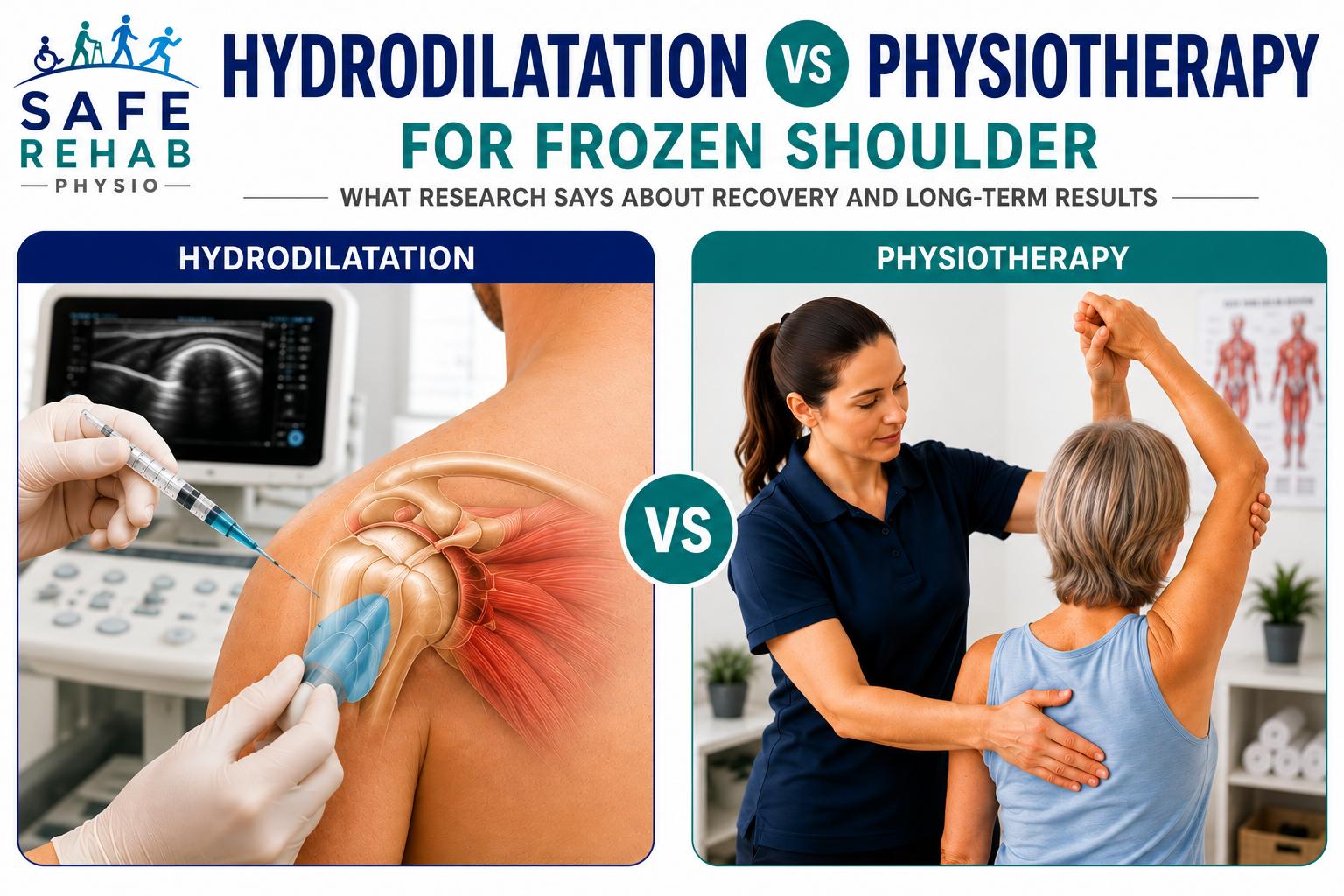
Hydrodilatation vs Physiotherapy for Frozen Shoulder: What Research Says About Recovery and Long-Term Results
Frozen shoulder, also called adhesive capsulitis, is a painful condition that causes severe shoulder stiffness and progressive loss of movement.
Many patients struggle with:
- Difficulty lifting the arm
- Pain while dressing
- Severe night pain
- Difficulty sleeping
- Reduced shoulder movement
- Pain during daily activities
- Loss of strength and function
Frozen shoulder can become extremely frustrating because recovery is often slow and may last many months.
Two common treatments often discussed are:
- Hydrodilatation with steroid injection
- Physiotherapy rehabilitation
Many patients ask:
“Which treatment works better?”
The answer depends on:
- Stage of frozen shoulder
- Pain severity
- Stiffness severity
- Functional limitations
- Response to previous treatment
Research shows both treatments may help, but physiotherapy remains one of the most important long-term rehabilitation strategies.
What Is Frozen Shoulder?
Frozen shoulder is a condition where the shoulder capsule becomes:
- Inflamed
- Thickened
- Tight
- Painful
- Stiff
This causes major restriction of shoulder movement. The condition commonly affects:
- Adults aged 40–65
- People with diabetes
- Patients after injury or surgery
- People with prolonged shoulder immobility
Common Symptoms of Frozen Shoulder
Typical symptoms include:
- Severe shoulder pain
- Progressive stiffness
- Difficulty reaching overhead
- Difficulty reaching behind the back
- Pain at night
- Difficulty sleeping on the shoulder
- Reduced arm movement
- Pain while dressing
- Difficulty washing hair
- Weakness due to reduced movement
Pain often becomes worse at night because inflammation and shoulder compression increase while lying down.
Stages of Frozen Shoulder
Frozen shoulder usually develops gradually in stages.
1. Freezing Stage
Common symptoms:
- Increasing pain
- Severe night pain
- Progressive stiffness
- Pain with movement
This stage may last several months.
2. Frozen Stage
Common symptoms:
- Less pain
- Severe stiffness
- Major movement restriction
- Difficulty with daily tasks
This stage may continue for months.
3. Thawing Stage
Common symptoms:
- Gradual movement improvement
- Reduced stiffness
- Improved function
Recovery may continue slowly over time.
What Is Hydrodilatation?
Hydrodilatation is a medical procedure used for frozen shoulder. The procedure usually involves:
- Steroid injection
- Saline fluid injection
- Local anaesthetic
Fluid is injected into the shoulder joint capsule to stretch the capsule, reduce inflammation, improve movement, and reduce pain. Hydrodilatation is normally performed using imaging guidance such as ultrasound or X-ray guidance.
What Do Steroid Injections Do?
Steroid injections aim to reduce inflammation inside the shoulder.
Benefits may include:
- Reduced pain
- Reduced inflammation
- Improved comfort
- Improved ability to move the shoulder
Research suggests injections may provide short-term pain relief, especially during painful early stages. However, injections alone usually do not fully restore long-term shoulder mobility without rehabilitation.
Benefits of Hydrodilatation
Research suggests hydrodilatation may help:
- Reduce pain
- Improve shoulder movement
- Reduce capsular tightness
- Improve function temporarily
- Improve tolerance to physiotherapy
Some patients notice improvement within days or weeks. Hydrodilatation may be particularly useful when pain is extremely severe, shoulder movement is very restricted, progress with physiotherapy alone is slow, or night pain is limiting rehabilitation.
Limitations of Hydrodilatation
Hydrodilatation is not a “magic cure.” Some limitations include:
- Recovery may still take months
- Stiffness can return
- Strength is not restored automatically
- Functional movement still needs retraining
- Some patients improve only temporarily
Without physiotherapy, the shoulder may remain weak, tight, dysfunctional, and poorly controlled. This is why rehabilitation remains essential.
The Role of Physiotherapy
Physiotherapy plays a major role in frozen shoulder recovery. Treatment focuses on:
- Restoring movement
- Improving shoulder mechanics
- Reducing stiffness
- Improving function
- Improving strength
- Reducing fear of movement
Evidence-based physiotherapy may include gentle stretching, joint mobilisation, mobilisations with movement (MWM), functional rehabilitation, postural correction, strengthening exercises, pain education, and activity modification.
Why Movement Is Important
Many patients avoid moving the shoulder because movement is painful. Unfortunately, avoiding movement completely may worsen stiffness, tightness, weakness, and functional limitation.
Safe guided movement is important to maintain joint mobility, muscle activity, shoulder function, and confidence. The key is controlled, progressive rehabilitation — not aggressive forcing.
Stretching Exercises for Frozen Shoulder
Stretching exercises are commonly used to improve mobility.
1. Pendulum Exercise
- How to perform: Lean forward slightly, let arm hang relaxed, move arm gently in circles.
- Benefits: Gentle movement, reduces stiffness, reduces guarding.
2. Wand Exercises
- How to perform: Hold stick with both hands, use unaffected arm to assist movement.
- Benefits: Improves shoulder movement, safe assisted mobility.
3. Wall Climbing Exercise
- How to perform: Walk fingers slowly up the wall.
- Benefits: Improves overhead reach, improves mobility gradually.
4. Cross-Body Stretch
- How to perform: Pull arm gently across chest.
- Benefits: Improves posterior shoulder flexibility.
5. Sleeper Stretch
- How to perform: Lie on affected side, rotate forearm gently downward.
- Benefits: Improves internal rotation.
Exercises should be gentle and progressive. Aggressive stretching may increase irritation during painful stages.
Mobilisations and MWM (Mobilisations With Movement)
Physiotherapists may use manual therapy techniques such as joint mobilisations, mobilisations with movement (MWM), capsular stretching, and soft tissue techniques.
MWM techniques aim to improve shoulder movement, pain-free motion, and functional reach. Research suggests manual therapy combined with exercise may improve outcomes for some patients.
Evidence-Based Outcomes
Research generally shows:
Hydrodilatation May Help:
- Short-term pain relief
- Temporary mobility improvement
- Improved comfort during painful stages
Physiotherapy May Help:
- Long-term functional recovery
- Shoulder mobility
- Strength
- Movement control
- Functional independence
Research often supports combining medical management, physiotherapy rehabilitation, and exercise progression rather than relying on injections alone.
When Combined Treatment Works Best
Many patients improve best with Hydrodilatation or steroid injection PLUS structured physiotherapy rehabilitation.
This combination may help because reduced pain allows better exercise participation, physiotherapy restores movement and function, strength improves gradually, and shoulder control improves.
Combined treatment may be especially useful when pain is severe, movement is extremely restricted, sleep is badly affected, and rehabilitation is limited by pain.
Recovery Expectations
Frozen shoulder recovery is usually gradual. Some patients improve within months. Others may continue improving over 12 months, 18 months, or sometimes longer.
Recovery depends on the stage of the condition, pain severity, stiffness severity, exercise consistency, rehabilitation quality, and general health. Patience and consistency are extremely important.
Dos and Don’ts
Dos
- Perform exercises consistently
- Move the shoulder regularly
- Maintain good posture
- Progress exercises gradually
- Follow physiotherapy advice
- Use pain management strategies appropriately
- Stay active within tolerance
Don’ts
- Avoid aggressive painful stretching
- Do not stop movement completely
- Avoid prolonged immobility
- Do not compare recovery with others
- Avoid forcing movement aggressively
- Do not ignore worsening symptoms
When Should You Seek Professional Help?
Seek professional assessment if you experience severe night pain, progressive stiffness, difficulty dressing, reduced arm movement, persistent shoulder pain, difficulty sleeping, major functional limitation, or no improvement over time. Early treatment often improves outcomes. Read more about the signs you may need home physiotherapy.
Final Thoughts
Hydrodilatation and steroid injections may help reduce pain and improve mobility temporarily in frozen shoulder. However, physiotherapy remains one of the most important long-term treatments for restoring shoulder movement, strength, function, confidence, and daily activity performance.
Evidence suggests the best outcomes often come from combining medical treatment, guided physiotherapy, progressive rehabilitation, and consistent exercises. Recovery may take time, but structured rehabilitation can significantly improve long-term shoulder function.
SAFE REHAB PHYSIO
Professional physiotherapy services helping patients improve:
- Frozen shoulder rehabilitation
- Shoulder stiffness
- Pain management
- Mobility
- Strength
- Functional recovery
- Rehabilitation at home
Serving patients across Berkshire, Buckinghamshire, Herefordshire and surrounding areas in the UK. See our locations or contact us today.
Evidence-Based Information
This article is based on evidence-based physiotherapy guidelines and internationally recognised frozen shoulder rehabilitation research.
References
- NICE Frozen Shoulder Management Guidelines
- British Elbow and Shoulder Society (BESS) Frozen Shoulder Pathway
- American Academy of Orthopaedic Surgeons (AAOS) Frozen Shoulder Information
- Cochrane Review on Adhesive Capsulitis Treatments
- Journal of Orthopaedic & Sports Physical Therapy (JOSPT) Frozen Shoulder Research
- Evidence for Hydrodilatation in Frozen Shoulder Research Studies
- Physiotherapy Rehabilitation Following Adhesive Capsulitis Research
- Mobilisation With Movement (MWM) Shoulder Rehabilitation Studies
- Shoulder Pain and Frozen Shoulder Physiotherapy Evidence Reviews
- World Physiotherapy Musculoskeletal Rehabilitation Guidance
Need Professional Home Physiotherapy?
Safe Rehab Physio provides expert home physiotherapy for post-operative recovery, post-fracture rehabilitation, pre-op conditioning, elderly mobility and falls prevention.