
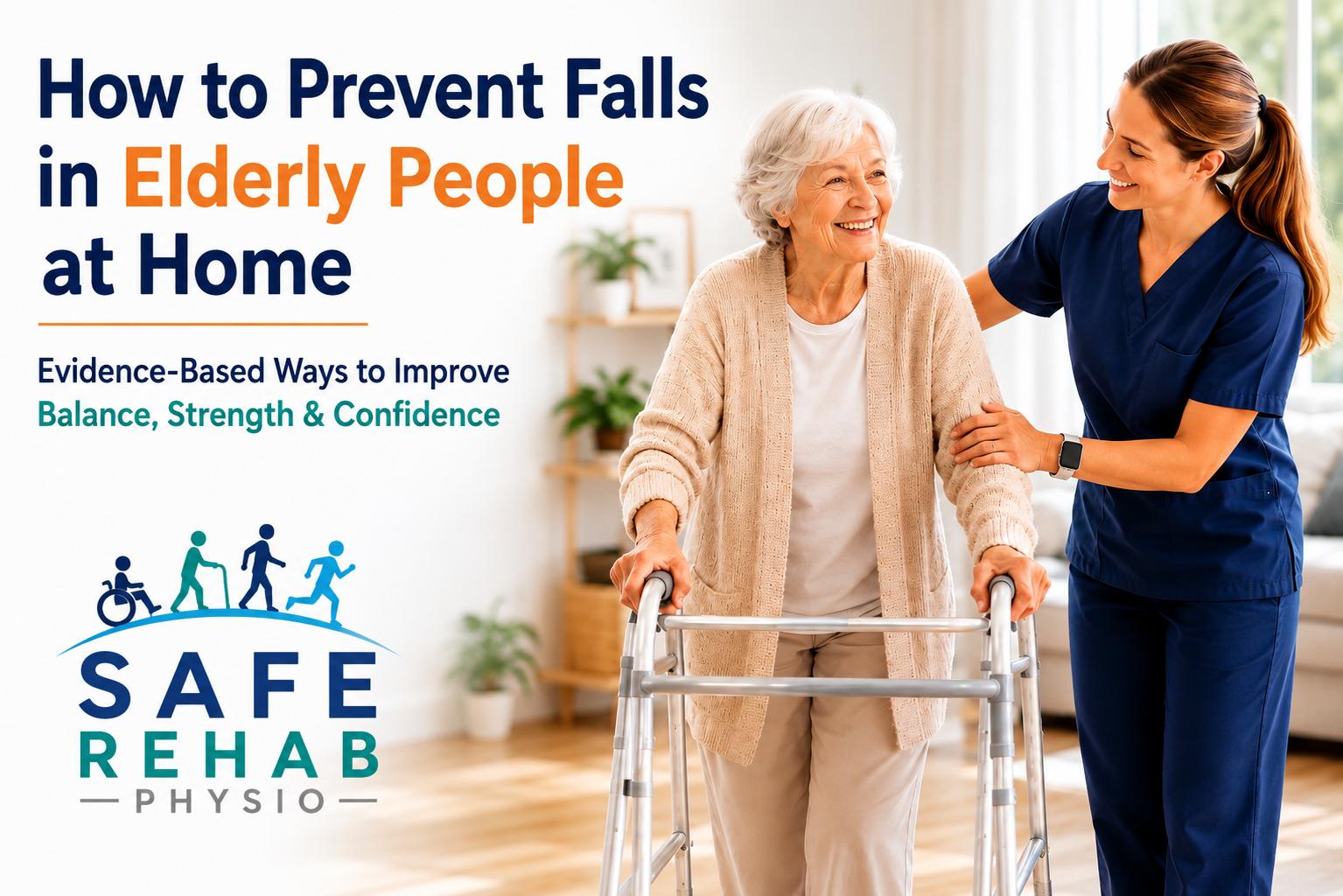
How to Prevent Falls in Elderly People at Home: Evidence-Based Ways to Improve Balance, Strength, and Confidence
Falls are one of the most common reasons older adults lose confidence, independence, and mobility.
Many elderly people become fearful after a fall — or even after feeling unsteady while walking. Families also become worried when they notice slower walking, weakness, balance problems, or repeated near-falls at home.
The good news is that many falls can be prevented with the right physiotherapy, exercises, home safety changes, and early intervention.
Research consistently shows that improving strength, balance, mobility, and home safety can significantly reduce the risk of falls in older adults.
Why Do Falls Happen in Elderly People?
Falls rarely happen because of a single reason. Usually, several factors combine together, including:
- Muscle weakness
- Poor balance
- Slower walking speed
- Joint stiffness
- Reduced confidence
- Poor eyesight
- Unsafe footwear
- Side effects of medications
- Previous falls
- Neurological conditions
- Arthritis
- Reduced physical activity
- Poor reaction time
- Unsafe home environments
As we age, the body naturally becomes less stable and less responsive to sudden movements or changes in balance. Even small problems can increase the risk of falling.
Common Balance Problems in Older Adults
Many elderly people notice:
- Feeling unsteady while walking
- Holding furniture while moving around
- Difficulty turning quickly
- Reduced confidence outdoors
- Fear of stairs
- Difficulty standing up from chairs
- Shuffling gait
- Slower reactions
- Dizziness or light-headedness
- Loss of confidence after illness or a hospital stay
Balance problems are extremely common after:
- Surgery (Hip or knee replacement)
- Fractures
- Long periods of bed rest
- Stroke
- Parkinson’s disease
- Chest infections or COVID-19
- Hospital admission
Without rehabilitation, these problems often worsen over time.
How Weak Muscles Increase Fall Risk
Muscle weakness is one of the biggest causes of falls. The legs, hips, core muscles, and ankles play a major role in keeping the body upright and stable.
When these muscles become weak:
- Walking becomes slower
- Balance reactions reduce
- Standing becomes difficult
- Stairs become unsafe
- Fatigue increases
- Confidence decreases
Research shows that older adults can lose muscle strength surprisingly quickly after inactivity or hospitalisation. Even a few days of reduced movement can lead to noticeable weakness. This is why early physiotherapy and strengthening exercises are so important.
Slow Walking and Shuffling Gait
Many elderly people develop a slower walking pattern over time. Common signs include:
- Small steps and shuffling feet
- Reduced arm swing
- Stooped posture
- Hesitation while walking
- Difficulty turning
- Needing support from furniture
Slow walking is not always “just old age.” It may indicate weakness, reduced balance, pain, fear of falling, or neurological conditions. Physiotherapy can help retrain safer walking patterns and improve mobility.
Poor Footwear Can Increase Falls
Unsafe footwear is a very common but often overlooked cause of falls.
Shoes should provide:
- Good grip
- Proper support
- Flat, stable soles
- Secure fitting
- Comfortable cushioning
Avoid:
- Loose slippers
- High heels
- Socks on smooth floors
- Backless footwear
- Worn-out soles
Good footwear improves stability and confidence while walking.
Unsafe Home Environments
Many falls happen inside the home. Common hazards include:
- Loose rugs and wet floors
- Poor lighting
- Cluttered walkways and electrical cables
- Slippery bathrooms
- Unsafe stairs
- Low chairs
- Pets underfoot
Small home modifications can greatly reduce fall risk.
Evidence-Based Exercises to Improve Balance
Research strongly supports exercise-based rehabilitation for fall prevention. The most effective programmes usually include:
- Strength training
- Balance retraining
- Functional mobility exercises
- Walking practice
- Sit-to-stand exercises
- Gait re-education
These exercises help improve muscle strength, reaction time, confidence, walking ability, coordination, and stability.
5 Simple Balance Exercises for Older Adults
(Note: Always hold onto a stable surface like a kitchen counter for safety when trying these.)
1. Sit-to-Stand Exercise
One of the best functional exercises.
- How to Perform: Sit in a stable chair. Stand up slowly. Sit back down with control. Repeat 8–12 times.
- Benefits: Improves leg strength, improves transfers, helps with stair climbing, improves independence.
2. Heel Raises
- How to Perform: Hold a counter for support. Rise onto your toes slowly. Lower slowly. Repeat 10–15 times.
- Benefits: Improves ankle strength, improves walking stability, helps balance reactions.
3. Marching on the Spot
- How to Perform: Hold support if needed. Lift one knee at a time. March slowly for 30–60 seconds.
- Benefits: Improves coordination, improves balance, improves hip strength.
4. Side Leg Raises
- How to Perform: Hold support. Lift your leg sideways slowly. Keep your body upright. Repeat 10 times on each side.
- Benefits: Strengthens hip muscles, improves pelvic stability, helps walking balance.
5. Tandem Standing
- How to Perform: Stand with one foot in front of the other. Hold support initially. Maintain balance for 10–30 seconds.
- Benefits: Challenges the balance system, improves stability, reduces fall risk.
The Importance of Walking Aids
Walking aids (like walking sticks, quad sticks, crutches, zimmer frames, or rollators) can improve safety and confidence when used correctly.
However, incorrect height or poor usage can increase the risk of falls.
A physiotherapist can assess:
- The correct walking aid for your needs
- Proper height adjustment
- Safe walking technique
- Indoor and outdoor mobility
Physiotherapy Benefits for Falls Prevention
Physiotherapy plays a major role in reducing falls. A physiotherapist can assess your balance, walking pattern, strength, joint stiffness, pain, transfers, home safety, and functional mobility.
Treatment may include:
- Strengthening exercises
- Balance retraining
- Gait re-education
- Manual therapy
- Mobility training
- Falls education
- Functional rehabilitation
- Confidence building
Evidence shows that structured physiotherapy programmes can significantly reduce fall risk and improve independence in older adults.
10 Simple Ways to Make Your Home Safer (Safety Checklist)
- ✓ Remove loose rugs
- ✓ Improve lighting
- ✓ Keep walkways clear
- ✓ Install grab rails in bathrooms
- ✓ Use non-slip mats
- ✓ Wear supportive footwear
- ✓ Avoid clutter on stairs
- ✓ Keep frequently used items easy to reach
- ✓ Ensure walking aids are safe and adjusted correctly
- ✓ Encourage regular movement and exercise
When Should You Seek Physiotherapy?
You should consider a professional physiotherapy assessment if an elderly person:
- Has fallen recently
- Feels unsteady while walking
- Walks slower than before
- Holds furniture while walking
- Has reduced confidence
- Struggles with stairs
- Has weakness after illness or surgery
- Avoids activity due to fear of falling
Early rehabilitation can often prevent further decline and improve long-term independence.
Final Thoughts
Falls are not an inevitable part of ageing. Many falls can be prevented through strengthening exercises, balance retraining, safe walking practice, home modifications, and early physiotherapy intervention. Improving mobility, confidence, and physical strength can help elderly people remain safer, more active, and more independent at home.
SAFE REHAB PHYSIO
Professional home physiotherapy services helping elderly patients improve mobility, balance, strength, confidence, independence, falls prevention, post-operative recovery, and rehabilitation at home.
Serving patients across Berkshire, Buckinghamshire, Herefordshire, and surrounding areas in the UK.
References
1. CDC Falls Prevention Guidelines
2. NICE Falls Prevention Guidelines
3. WHO Falls Fact Sheet
4. Otago Exercise Programme Research
5. ACSM Physical Activity Guidelines
6. USPSTF Falls Prevention Recommendations
7. Physio-Pedia Otago Programme
8. Frontiers in Public Health Research
9. HQSC New Zealand Falls Prevention
10. University of Otago Falls Research
Need Professional Home Physiotherapy?
Safe Rehab Physio provides expert home physiotherapy for post-operative recovery, post-fracture rehabilitation, pre-op conditioning, elderly mobility and falls prevention.