
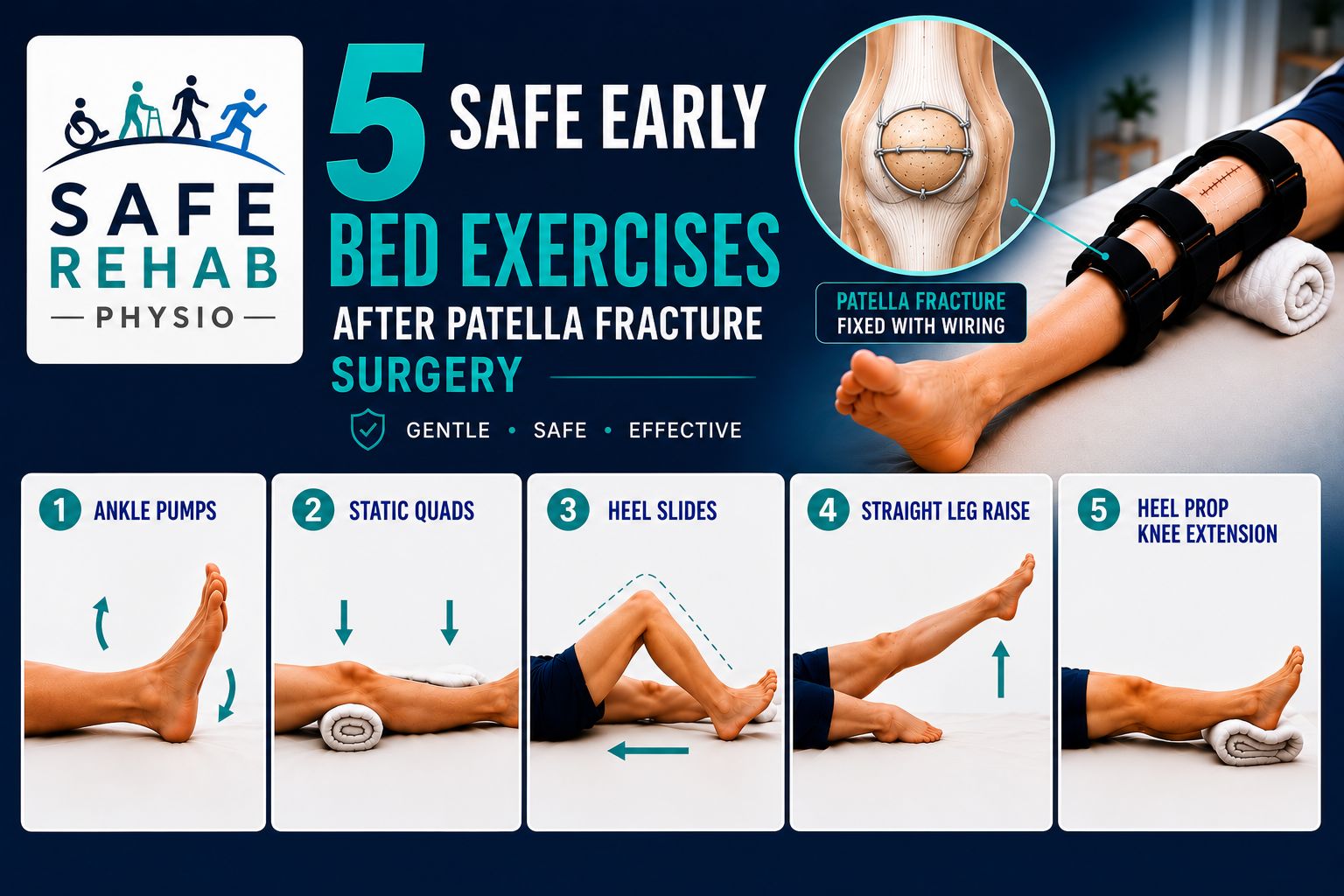
5 Safe Early Bed Exercises After Patella Fracture Surgery
A Simple Guide for Early Knee Recovery (Wiring/ORIF)
Recovering after patella (kneecap) fracture surgery can feel worrying. Many patients are afraid to move the knee for fear of damaging the surgical wiring or the healing bone. However, complete rest for too long can actually slow recovery.
Gentle early exercises are recommended by physiotherapists to improve circulation, reduce stiffness, and maintain muscle activity. This guide outlines safe, bed-based movements to help you prepare for walking again.
⚠️ Important Safety Advice
Stop immediately and seek medical advice if you notice:
- Severe or worsening pain
- Sudden swelling or fever
- Increased redness, heat, or wound leakage
- Calf pain (potential blood clot)
- Feeling unstable or unsafe
Always follow your specific weight-bearing instructions and surgeon’s protocol.
Why Early Movement Matters
After surgery, the knee becomes stiff quickly and thigh muscles (quadriceps) “switch off.” Gentle exercises help:
- Improve Circulation: Reducing the risk of blood clots (DVT).
- Manage Swelling: Moving the muscles helps pump fluid away from the joint.
- Prevent Stiffness: Maintaining the “glide” of the joint surfaces.
- Protect the Fixation: Isometric exercises (tightening without moving) build strength without stressing the fracture site.
The Exercises
1. Ankle Pumps
- Action: Move your foot upward toward you and then point it downward slowly.
- Frequency: Repeat gently and rhythmically (e.g., 20 reps every hour).
- Benefit: This is the most important exercise for preventing blood clots and reducing lower leg swelling.
2. Static Quadriceps Contractions
- Action: Lie with the operated leg straight. Tighten the muscles at the front of the thigh by gently pressing the back of your knee downward into the bed.
- Hold: 5 seconds, then relax.
- Benefit: Wakes up the “quads” which are essential for walking, without moving the actual knee joint.
3. Heel Slides
- Action: Slowly slide your heel toward your bottom, bending the knee slightly. Straighten the leg slowly again.
- Limit: Only move within a comfortable range (usually limited to 30–90 degrees early on based on surgeon instructions).
- Benefit: Gently restores bending (flexion) and prevents the joint capsule from tightening.
4. Straight Leg Raise (SLR)
- Action: Bend your non-operated knee (foot flat on bed). Tighten the thigh of the operated leg and lift the whole leg 6–10 inches off the bed.
- Note: Only perform this if you can keep the knee perfectly straight while lifting.
- Benefit: Builds significant hip and thigh strength required for using stairs and walking.
5. Heel Prop (Knee Straightening)
- Action: Place a small rolled towel or pillow under your heel only, allowing gravity to pull the knee straight.
- Duration: Relax in this position for 2–5 minutes.
- Benefit: Regaining full extension (straightness) is vital. A knee that heals even slightly “bent” causes a limp and long-term pain.
Recovery Checklist
| DO | DON’T |
|---|---|
| Follow professional advice carefully | Force movements through sharp pain |
| Perform exercises regularly and gently | Bend the knee aggressively/quickly |
| Control swelling with elevation | Walk without your prescribed aids |
| Keep the wound clean and dry | Sit with the knee bent for long periods |
| Be patient—healing takes time | Stop exercises because of “fear” |
The Role of Home Physiotherapy
A physiotherapist visiting you at home can ensure you are performing these movements correctly and safely. They provide:
- Personalized Progression: Knowing exactly when to increase the difficulty.
- Gait Training: Learning to walk correctly with crutches or a frame.
- Confidence: Helping you overcome the fear of moving your “new” knee.
Final Thoughts: Recovery is a marathon, not a sprint. By performing these simple bed exercises, you are laying the foundation for a full return to independence.
References
- American Academy of Orthopaedic Surgeons
Early controlled mobilisation and quadriceps activation after patellar fracture fixation are commonly recommended to reduce stiffness, muscle wasting, and functional decline following surgery. - National Institute for Health and Care Excellence (NICE)
NICE guidance highlights the importance of early rehabilitation, mobility training, strengthening exercises, and prevention of complications such as deep vein thrombosis and joint stiffness after orthopaedic surgery. - Boström A.
“Fracture of the Patella: A Study of 422 Patellar Fractures.”
Acta Orthopaedica Scandinavica. 1972;43(Sup143):1–80.
Classic orthopaedic research discussing outcomes and rehabilitation following patellar fracture management. - Carpenter JE, Kasman R, Matthews LS.
“Fractures of the Patella.”
The Journal of Bone and Joint Surgery. 1993;75(10):1550–1561.
Evidence discussing fixation techniques, rehabilitation principles, and functional recovery after patellar fractures. - Lazaro LE, Wellman DS, Pardee NC, et al.
“Effect of Computer Tomography on Classification and Treatment Planning of Patellar Fractures.”
Journal of Orthopaedic Trauma. 2013;27(6):336–344.
Highlights modern understanding of patellar fracture management and rehabilitation progression. - Gwinner C, Märdian S, Schwabe P, et al.
“Current Concepts Review: Fractures of the Patella.”
GMS Interdisciplinary Plastic and Reconstructive Surgery DGPW. 2016;5:Doc01.
Evidence-based review of surgical treatment and post-operative rehabilitation strategies for patellar fractures. - Smith TO, Davies L, Hing CB.
“Early Versus Delayed Mobilisation Following Surgical Fixation of Patellar Fractures.”
Physiotherapy Research International.
Research supports appropriately guided early mobilisation to improve functional outcomes and reduce knee stiffness. - American Physical Therapy Association
Physiotherapy guidelines emphasise quadriceps strengthening, gait retraining, swelling management, and progressive range-of-motion exercises after knee surgery. - Kannus P, Järvinen M.
“Conservatively Treated Tears of the Quadriceps Femoris Muscle.”
Sports Medicine. 1992.
Supports the role of isometric strengthening exercises in maintaining muscle activation safely during early rehabilitation phases. - Kisner C, Colby LA, Borstad J.
Therapeutic Exercise: Foundations and Techniques.
Need Professional Home Physiotherapy?
Safe Rehab Physio provides expert home physiotherapy for post-operative recovery, post-fracture rehabilitation, pre-op conditioning, elderly mobility and falls prevention.